
Table of Contents
- What Is an Affiliate Program?
- Why Your Choice Matters
- Know Your Audience First
- Match the Program to Your Niche
- Understanding Commission Models
- Why Cookie Duration Matters
- Payment Methods and Minimum Payouts
- How to Evaluate an Affiliate Program's Reputation
- Red Flags to Watch Out For
- Frequently Asked Questions
- Key Takeaways
What Is an Affiliate Program?
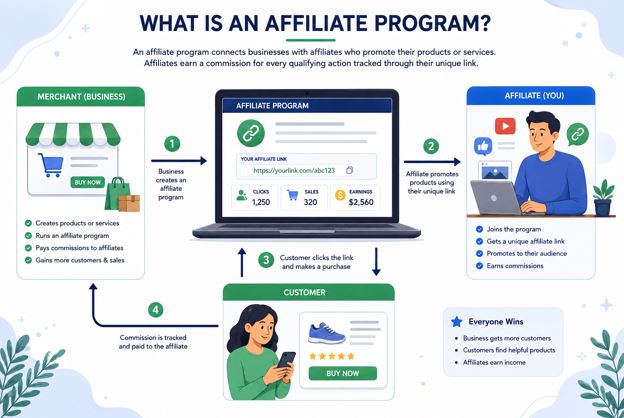
An affiliate program is a partnership between a business and individuals or publishers who promote its products or services. When someone clicks an affiliate link and completes a qualifying action—such as making a purchase or signing up for a service—the affiliate earns a commission.
Affiliate programs exist in almost every industry, including technology, finance, education, software, travel, fashion, health, and e-commerce. They provide businesses with a performance-based marketing channel while giving content creators, bloggers, website owners, and influencers an opportunity to monetize their audience without creating their own products.
However, not all affiliate programs are equal. Two programs in the same niche can differ significantly in commission rates, tracking accuracy, payment reliability, support quality, and conversion performance. Choosing the wrong program can result in wasted effort, lower earnings, and reduced trust with your audience.
Pro Tip
Instead of asking, "Which affiliate program pays the highest commission?", ask "Which affiliate program offers the best overall value for my audience?" Programs with excellent products and higher conversion rates often generate more income than those advertising large commissions but struggling to convert visitors.
Why Choosing the Right Affiliate Program Matters
Many beginners focus almost entirely on commission percentages. While commission is important, it represents only one part of a much larger picture. A sustainable affiliate marketing strategy is built on trust, relevance, and long-term relationships with your audience.
Imagine recommending a product with a 60% commission that receives poor customer reviews, delivers disappointing results, or offers unreliable support. Even if you earn a few initial commissions, your audience may lose confidence in your recommendations and become less likely to follow your future advice.
On the other hand, recommending a well-established product with a lower commission but a strong reputation can increase conversions, encourage repeat purchases, and strengthen your credibility over time. Successful affiliate marketers understand that long-term trust is often more valuable than short-term earnings.
Why Successful Affiliates Earn More
Successful affiliates rarely promote every available product. They carefully select products that solve genuine problems for their audience. This approach leads to better engagement, stronger recommendations, and higher conversion rates over time.
As you continue through this guide, you'll learn how to evaluate affiliate programs beyond their advertised commission rates so you can choose opportunities that support both your readers and your long-term business goals.
Know Your Audience Before Choosing an Affiliate Program
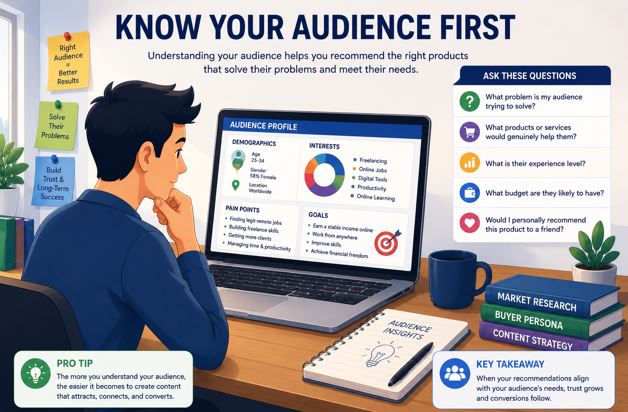
One of the biggest mistakes beginners make is joining affiliate programs simply because they offer attractive commission rates. While high commissions may seem appealing, they don't guarantee sales. The most successful affiliate marketers start by understanding their audience's needs, challenges, and purchasing behavior before selecting products to promote.
Think about why people visit your website. Are they looking for educational content, practical tools, product comparisons, software recommendations, or step-by-step tutorials? Every recommendation you make should naturally fit the reason they came to your site.
For example, a visitor reading an article about finding remote jobs is unlikely to be interested in luxury watches or gaming accessories. However, they may appreciate recommendations for resume builders, online learning platforms, productivity software, or job search tools that help them achieve their goals.
Ask Yourself These Questions
- What problem is my audience trying to solve?
- What products or services would genuinely help them?
- What is their experience level?
- What budget are they likely to have?
- Would I personally recommend this product to a friend?
When your recommendations align with your audience's interests, your content feels more authentic. This improves reader trust, increases click-through rates, and often leads to better conversion rates over time.
Choose Affiliate Programs That Match Your Niche
Your niche should guide every affiliate marketing decision you make. Promoting unrelated products may generate occasional clicks, but it rarely builds a sustainable business. Search engines and readers both reward websites that maintain clear topical focus.
For example, if your website focuses on online jobs and freelancing, your affiliate offers should naturally complement those topics instead of distracting from them.
| Website Niche | Good Affiliate Products | Poor Match |
|---|---|---|
| Remote Jobs | Resume builders, online courses, productivity software | Kitchen appliances |
| Freelancing | Invoicing software, portfolio builders, web hosting | Luxury fashion |
| Personal Finance | Budgeting apps, investment platforms, finance books | Gaming accessories |
| Fitness | Workout equipment, nutrition programs, fitness apps | Office software |
Matching affiliate products with your niche improves user experience and increases the likelihood that visitors will take action. Readers are far more likely to trust recommendations that naturally fit the topic they're already interested in.
Practical Example
At PrimoWork, articles about freelancing can naturally recommend portfolio builders, online learning platforms, productivity tools, and website hosting services. These recommendations provide additional value without interrupting the reader's experience.
Understand Different Affiliate Commission Models
Not every affiliate program pays commissions in the same way. Understanding the different commission models helps you compare programs more accurately and choose those that fit your content strategy.
| Commission Model | How It Works | Best For |
|---|---|---|
| Cost Per Sale (CPS) | You earn a commission when someone makes a purchase. | Product reviews and buying guides. |
| Cost Per Action (CPA) | You earn when users complete an action such as signing up. | Lead generation content. |
| Recurring Commission | You continue earning while the customer remains subscribed. | Software and subscription services. |
| Revenue Share | You receive a percentage of the company's ongoing revenue. | Long-term partnerships. |
| Hybrid Model | Combines upfront and recurring commissions. | Premium affiliate programs. |
Recurring commission programs are often attractive because they can generate consistent income from a single successful referral. However, they should still be evaluated based on product quality, customer satisfaction, and retention—not just commission potential.
Don't Chase Commission Rates Alone
A product with a 10% commission and a high conversion rate may generate significantly more revenue than another product offering 60% commission but attracting very few buyers. Always consider the complete picture: audience relevance, conversion rate, product quality, and long-term trust.
In the next section, we'll explore another factor that many beginners overlook but which can have a major impact on your earnings: cookie duration, how referral tracking works, and why it matters when comparing affiliate programs.
Why Cookie Duration Matters More Than Most Beginners Realize
Cookie duration determines how long an affiliate program remembers that a visitor came through your referral link. If someone clicks your affiliate link today but purchases later, you only receive credit if the purchase happens before the cookie expires.
This is one of the most overlooked factors when comparing affiliate programs. A program offering a 20% commission with a 90-day cookie can sometimes outperform a program offering 40% commission with a 24-hour cookie because customers often need time to research products before buying.

| Cookie Duration | Best For | Typical Buying Behavior |
|---|---|---|
| 24 hours | Low-cost impulse purchases | Quick decisions |
| 7 days | Simple consumer products | Short research period |
| 30 days | Software, courses, and services | Moderate research |
| 60–90 days | High-ticket products and B2B tools | Longer decision process |
For PrimoWork's audience—people exploring online income, freelancing, remote work, and digital tools—a 30-day or longer cookie is usually preferable because readers often compare multiple platforms before purchasing.
Quick Evaluation Rule
When two affiliate programs offer similar commissions, choose the one with the longer cookie duration and better conversion rate. Those two factors usually have a bigger impact on real earnings than a small difference in commission percentage.
Payment Methods and Minimum Payouts
A surprisingly common beginner mistake is joining an affiliate program without checking how and when it pays affiliates. A program may look attractive until you discover that payments are available only through a method unsupported in your country or that the minimum payout threshold is unrealistically high.
Common Payment Methods
| Payment Method | International Friendly | Typical Processing Time |
|---|---|---|
| Bank Transfer | Good | 2–7 business days |
| PayPal | Excellent | Instant to 24 hours |
| Payoneer | Excellent | 1–3 business days |
| Wise | Excellent | 1–2 business days |
| Check | Limited | Several weeks |
For many international affiliates, including readers in Nigeria and other emerging markets, programs that support Payoneer, Wise, or international bank transfers are often more practical than programs that pay only by paper check.
Minimum Payout Thresholds
Also check the minimum amount required before you can withdraw earnings.
| Minimum Payout | Beginner Friendly? | Why It Matters |
|---|---|---|
| $10–$25 | Excellent | You receive earnings quickly. |
| $50 | Good | Reasonable for growing affiliates. |
| $100 | Fair | May delay first payment. |
| $250+ | Poor for beginners | Can take months to reach. |
Avoid This Beginner Trap
A program with a high payout threshold and low traffic conversion can leave your earnings locked for a long time. Early cash flow matters because it allows you to reinvest in better content, tools, and website improvements.
How to Evaluate an Affiliate Program's Reputation
Before joining any affiliate program, spend a few minutes researching its reputation. Reliable programs pay on time, track referrals accurately, provide responsive support, and maintain transparent terms and conditions.
Look for These Signals
- Public company or well-established brand
- Clear commission structure
- Transparent cookie and attribution rules
- Regular payment history
- Responsive affiliate support team
- Positive reviews from experienced affiliates
- Professional affiliate dashboard and reporting tools
Search for phrases such as "Program Name affiliate payment reviews" or "Program Name affiliate complaints". One or two negative comments are normal, but repeated reports of delayed payments, missing commissions, or account closures without explanation should be treated as warning signs.
A Simple Research Habit
Spend at least 15 minutes researching any affiliate program before applying. That small investment of time can prevent months of promoting a program that fails to pay reliably or support its affiliates properly.
Why Cookie Duration Matters More Than Most Beginners Realize
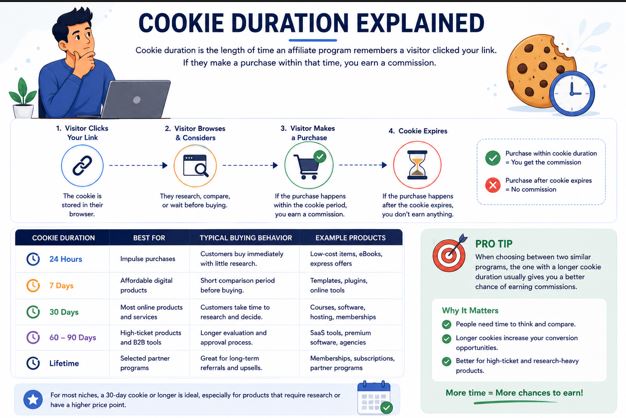
Cookie duration refers to the amount of time an affiliate program remembers that a visitor clicked your referral link. If the visitor completes a qualifying purchase within that period, you generally receive the commission according to the program's terms.
Many new affiliates ignore cookie duration and focus only on commission percentages. However, a longer cookie window can significantly improve your earning potential, especially for products that require customers to research before making a purchase.
Imagine a visitor reads your product review today but decides to compare alternatives before buying. If the affiliate program has a short tracking period, your referral may expire before they return. A longer cookie duration gives your recommendation more time to convert into a commission.
| Cookie Duration | Best For | Typical Buying Behaviour |
|---|---|---|
| 24 Hours | Impulse purchases | Customers usually buy immediately. |
| 7 Days | Affordable digital products | Short comparison period. |
| 30 Days | Most online products and services | Allows time for research. |
| 60–90 Days | High-ticket products | Long buying decisions. |
| Lifetime | Selected partner programs | Excellent for long-term referrals. |
Practical Tip
Never judge an affiliate program by commission alone. Compare the commission rate together with cookie duration, conversion rate, product quality, and customer satisfaction to understand the program's real earning potential.
Payment Methods and Minimum Payout Requirements
Getting paid should be straightforward. Before investing time creating content, verify how an affiliate program pays its partners and whether those payment options are available in your country. Payment delays, high transfer fees, or unsupported methods can reduce the value of an otherwise excellent program.
| Payment Method | Advantages | Things to Consider |
|---|---|---|
| Bank Transfer | Reliable for large payments. | International transfer fees may apply. |
| PayPal | Fast and widely accepted. | Currency conversion fees may apply. |
| Payoneer | Popular among international affiliates. | Availability depends on your location. |
| Wise | Competitive exchange rates. | Not supported by every affiliate program. |
| Gift Cards | Useful for some platforms. | Less flexible than cash payments. |
You should also check the minimum payout threshold. Some affiliate programs allow withdrawals once you've earned a relatively small amount, while others require a much higher balance before payments are released.
Why Minimum Payout Matters
A lower payout threshold allows beginners to receive their first earnings sooner, helping confirm that their tracking and promotional strategy are working. Larger thresholds may delay your first payment even if you're generating commissions consistently.
How to Evaluate an Affiliate Program's Reputation
A professional-looking website doesn't automatically mean an affiliate program is trustworthy. Before joining any program, spend time researching its reputation. This simple step can save you months of frustration and protect your audience from poor products or unreliable businesses.
Look beyond marketing claims and focus on measurable indicators such as payment history, customer reviews, product quality, support responsiveness, and overall company transparency.
Affiliate Program Evaluation Checklist
- Does the company have a positive reputation?
- Are commissions clearly explained?
- Is the payment schedule transparent?
- Does the company provide reliable affiliate support?
- Are marketing materials regularly updated?
- Is the product genuinely useful?
- Does the website appear secure and professional?
- Can you find independent reviews from affiliates?
Warning Signs
Be cautious of affiliate programs that promise guaranteed earnings, hide important commission terms, frequently change their payment policies without notice, or provide little information about the company behind the program. Transparency is one of the strongest indicators of a trustworthy affiliate partnership.
Choosing a reputable affiliate program protects both your credibility and your audience's trust. A recommendation should strengthen your relationship with readers—not damage it.
Red Flags That Should Make You Avoid an Affiliate Program
Not every affiliate program deserves your time or your audience's trust. Some programs look attractive because they advertise unusually high commissions or make bold income claims, but they often have poor products, unreliable payment practices, or unclear terms. Learning to recognize warning signs early can save you countless hours and protect the reputation you've worked hard to build.
Before joining any affiliate program, take time to read its terms and conditions, review its support resources, and research independent feedback from affiliates and customers. A few minutes of research can prevent months of frustration.
Common Red Flags
- Promises of guaranteed or effortless income.
- Hidden commission rules or unclear payment terms.
- Poor customer reviews across multiple platforms.
- No visible contact information or company details.
- Very high commissions without explaining how they are funded.
- Slow or unresponsive affiliate support.
- Frequent complaints about missed or delayed payments.
- Poor-quality landing pages that reduce conversion rates.
- Products that don't genuinely solve customer problems.
Remember that your reputation is far more valuable than a single commission. Recommending trustworthy products consistently will help you build a loyal audience that returns to your content whenever they need advice.
Questions to Ask Before Joining an Affiliate Program
Every affiliate program is different. Asking the right questions before applying helps you compare opportunities objectively instead of relying on marketing claims.
Evaluation Checklist
- Does this product genuinely help my audience?
- Would I recommend it even without earning a commission?
- Is the commission structure easy to understand?
- How long is the cookie duration?
- What payment methods are available?
- How often are affiliates paid?
- Is there a minimum payout requirement?
- Does the company provide promotional resources?
- Can I contact affiliate support when I need help?
- Are there independent reviews confirming reliable payments?
If you cannot confidently answer these questions, spend more time researching before committing your efforts to promoting the program.
Popular Affiliate Networks for Beginners
Affiliate networks connect publishers with hundreds or even thousands of merchants through a single platform. They simplify application management, commission tracking, and payment processing, making them a practical starting point for many beginners.
| Affiliate Network | Best For | Notable Strength |
|---|---|---|
| Amazon Associates | Physical products | Large product selection. |
| CJ Affiliate | Established brands | Wide range of advertisers. |
| Impact | Digital services and SaaS | Advanced reporting tools. |
| ShareASale | Small and medium businesses | Diverse merchant categories. |
| PartnerStack | Software products | Strong recurring commission opportunities. |
Choose Quality Over Quantity
You don't need to join dozens of affiliate programs immediately. Start with one or two reputable programs that align with your niche, learn how they perform, and expand only when you have enough data to make informed decisions.
Common Mistakes Beginners Make When Choosing Affiliate Programs
Many affiliate marketers struggle not because affiliate marketing doesn't work, but because they make avoidable mistakes during the selection process. Understanding these pitfalls can help you build a stronger foundation from the beginning.
Avoid These Mistakes
- Choosing programs based only on commission percentage.
- Promoting products you haven't properly researched.
- Ignoring audience needs.
- Joining too many affiliate programs at once.
- Failing to read program terms and conditions.
- Not monitoring conversion performance.
- Recommending products solely because they pay well.
Successful affiliate marketing is built on credibility, consistency, and useful recommendations. Readers are more likely to trust content that prioritizes solving problems rather than maximizing commissions.
How to Test an Affiliate Program Before Fully Committing
You don't need to invest months promoting a new affiliate program before knowing whether it's a good fit. Start small by publishing a few high-quality articles, monitoring clicks, conversions, and audience feedback, then evaluate the results.
If the product receives positive engagement and your audience finds it valuable, gradually expand your promotional efforts. If performance remains weak despite quality content and targeted traffic, reassess whether the program matches your audience's needs.
Think Long Term
Affiliate marketing should be treated as a long-term business rather than a quick source of income. Choosing trustworthy programs and consistently creating helpful content builds sustainable results over time.
Frequently Asked Questions
1. Is it better to join one affiliate program or several?
If you're just starting, focus on one or two high-quality affiliate programs that closely match your niche. Managing a smaller number of programs allows you to learn how they perform, optimize your content, and build trust with your audience before expanding.
2. Can I join multiple affiliate programs in the same niche?
Yes. Many successful affiliate marketers compare products from different companies to help readers make informed decisions. Ensure your recommendations remain honest, balanced, and based on the value each product offers rather than commission rates alone.
3. What is a good affiliate commission rate?
There isn't a universal answer because commission structures vary by industry. Instead of focusing only on percentages, consider product quality, conversion rates, cookie duration, and customer satisfaction. A lower commission on a trusted product often outperforms a higher commission on a poor-quality product.
4. Do I need a website to join an affiliate program?
Some affiliate programs require a website, while others accept applicants who promote products through social media, YouTube, newsletters, or other platforms. Always review each program's application requirements before applying.
5. How can I tell if an affiliate program is trustworthy?
Research the company, read independent reviews, check payment history where available, evaluate customer feedback, and carefully review the affiliate terms and conditions. Transparent companies usually provide clear commission structures, payment schedules, and support channels.
6. Should I promote products I haven't personally used?
Whenever possible, recommend products you have tested or thoroughly researched. If you haven't used a product yourself, be transparent about that and base your recommendation on credible information rather than exaggerated marketing claims.
7. Why are my affiliate links getting clicks but not sales?
Low conversions may indicate that the product isn't the right fit for your audience, the landing page doesn't convert well, or visitors need more information before making a purchasing decision. Review your content, audience intent, and product relevance rather than assuming the affiliate program is the problem.
8. How often should I review my affiliate partnerships?
Review your affiliate programs regularly. Product quality, commission structures, payment policies, and customer experiences can change over time. Periodic reviews help ensure you're still recommending products that benefit your audience.
Key Takeaways
- Choose affiliate programs based on audience needs rather than commission rates alone.
- Promote products that naturally fit your niche and provide genuine value.
- Compare commission models, cookie duration, payment methods, and payout requirements before joining.
- Research every affiliate program's reputation and avoid companies with poor transparency or unreliable payment histories.
- Start with a small number of quality affiliate partnerships and expand only after measuring results.
- Protect your credibility by recommending products you genuinely believe can help your readers.